
Biomass and waste gasification
Fluidized-bed gasification experiments and CPFD/CFD simulation: syngas quality, tar, staged oxygen, co-gasification with biochar, integration with industrial processes.
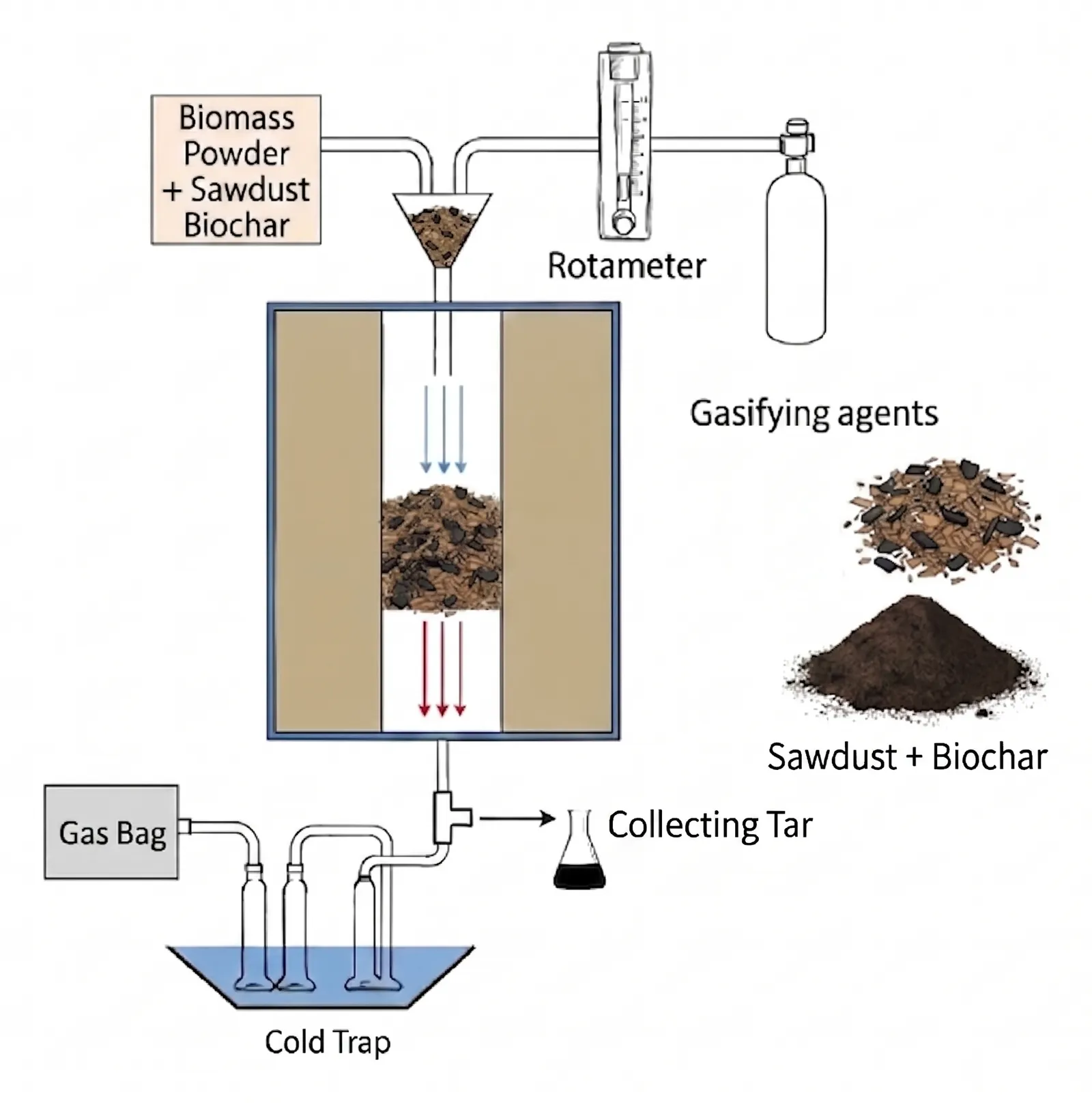
The lab studies gasification of biomass and waste as a route to clean syngas for fuels, chemicals and industrial processes. Experiments use a bubbling fluidized-bed gasifier with CO₂/O₂ blends and Winkler-type staged oxygen injection, and co-gasification of sawdust with biochar to raise the H₂ and CO content of the syngas and lower the tar yield.
Simulation work covers CPFD modelling of a full-loop circulating fluidized bed in Barracuda Virtual Reactor, fluidized-bed gasification models for aviation-fuel feedstock, and Aspen Plus process models that integrate gasification with a blast furnace and with existing coal-fired power plants.
Current topics
- CO₂/O₂-blown bubbling fluidized-bed gasification with staged oxygen injection
- Co-gasification of biomass and biochar for high-quality syngas
- CPFD simulation of circulating fluidized-bed gasifiers
- Gasification integrated with blast furnaces and coal-fired power plants
Theses in progress
Co-gasification of biomass with biochar for high-quality syngas
Josh Felix Rajagukguk, master's student
Experimental study of CO₂/O₂-blown biomass gasification in a bubbling fluidized bed using Winkler-type staged oxygen injection
Reyhan Ubadillah, undergraduate researcher
Process simulation study on retrofitting carbon capture and biomass gasification into an existing subcritical coal-fired power plant: a case study of PLTU Pelabuhan Ratu
Hadid Kusuma Ryandi, undergraduate researcher
CPFD simulation of sawdust gasification in a circulating fluidized bed using Barracuda Virtual Reactor: influence of oxygen-to-biomass ratio and steam-to-biomass ratio on tar formation kinetics and syngas quality
Valditino Ivanov Subiyantoro, master's student
Co-firing of biomass syngas with natural gas: effect of tar content on emissions and temperature performance
M Yoga Pratama, master's student
Numerical simulation of biomass gasification in a fluidized-bed reactor for sustainable aviation fuel production
Dita Ardiyanto, undergraduate researcher
Thermodynamic analysis of biomass gasification: integration into the blast furnace process
Ahmad Salman Rosali, master's student
Publications
All publicationsRousseva A., Gautam R., Zaini I. N., Aljaziri J., Govender N. S., Ledwaba L. P., Overmans S., Lauersen K. J., Sarathy S. M. (2025). Valorization of Cyanidioschyzon merolae via mixed air/steam/CO₂ gasification: Syngas evolution and tar molecular insights. ACS Omega 10 (44), 52783–52793. doi:10.1021/acsomega.5c06835
Wang S., Wang Y., Shi Z., Sun K., Wen Y., Niedzwiecki L., Pan R., Xu Y., Zaini I. N., Jagodzińska K., Aragon-Briceno C., Tang C., Onsree T., Tippayawong N., Pawlak-Kruczek H., Jönsson P. G., Yang W., Jiang J., Kawi S., Wang C.-H. (2023). Van Krevelen diagrams based on machine learning visualize feedstock-product relationships in thermal conversion processes. Communications Chemistry 6, 273. doi:10.1038/s42004-023-01077-z
Zaini I. N., Nurdiawati A., Gustavsson J., Wei W., Thunman H., Gyllenram R., Samuelsson P., Yang W. (2023). Decarbonising the iron and steel industries: Production of carbon-negative direct reduced iron by using biosyngas. Energy Conversion and Management 281, 116806. doi:10.1016/j.enconman.2023.116806
Nurdiawati A., Zaini I. N., Wei W., Gyllenram R., Yang W., Samuelsson P. (2023). Towards fossil-free steel: Life cycle assessment of biosyngas-based direct reduced iron (DRI) production process. Journal of Cleaner Production 393, 136262. doi:10.1016/j.jclepro.2023.136262