Sustainable aviation fuel and Power-to-Liquid
Fischer–Tropsch SAF routes from gasification and electrolysis hydrogen: process simulation, techno-economics and life-cycle assessment.
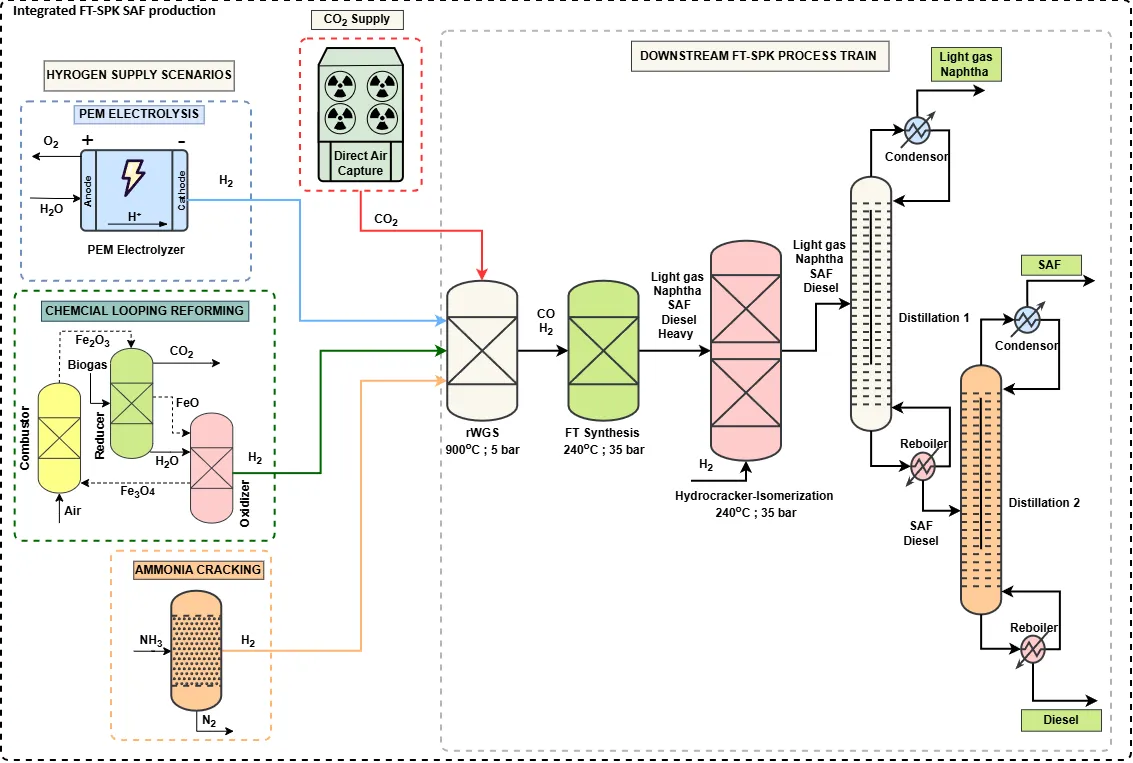
The lab evaluates routes to sustainable aviation fuel (SAF) through Fischer–Tropsch synthetic paraffinic kerosene. Power-to-Liquid process models in Aspen Plus combine direct air capture, reverse water-gas shift, Fischer–Tropsch synthesis, hydrocracking and distillation, and compare hydrogen supplied by PEM electrolysis, chemical-looping reforming and ammonia cracking.
Gasification-based routes are compared with conventional waste-cooking-oil pathways by life-cycle and techno-economic assessment, and fluidized-bed gasification is modelled to supply syngas of the right composition for SAF synthesis.
Current topics
- Fischer–Tropsch SAF from multi-scenario hydrogen sources
- Life-cycle and techno-economic comparison of SAF routes
- Syngas quality for SAF synthesis from biomass gasification
- Electrochemical Fischer–Tropsch for low-carbon liquid fuels
Theses in progress
Thermodynamic and techno-economic analysis of sustainable aviation fuel production from multi-scenario hydrogen sources
Alfian Satria Nugraha, master's student
Comparative life cycle and techno-economic assessment of SAF via gasification vs. conventional waste oil
Rafka Mahendra Pradiptaya, undergraduate researcher
Numerical simulation of biomass gasification in a fluidized-bed reactor for sustainable aviation fuel production
Dita Ardiyanto, undergraduate researcher
Electrified tar reforming towards syngas electrochemical Fischer–Tropsch for low-carbon fuel
Aldricho Alpha Pollardo, doctoral student